2/23/2010

Joining the Gaza Freedom March


In December, I headed off to Egypt to join the Gaza Freedom March alongside another 1300 marchers. The initial plan was to head into Gaza to march in solidarity with the Palestinians on the anniversary of the 2008 bombing, to protest the conditions of the occupation and the construction of a massive steel wall to completely seal off the underground smuggling routes. While those routes are admittedly also used for smuggling weapons, they had been the only means for getting medicine, food, construction supplies, and goods for the local market into the Gaza strip region.

In hindsight I might have been naive in expecting that we'd be allowed into Gaza, but I felt that this was something that I needed to at least attempt.  Through the Couchsurfing website I had managed to get in contact with a few politically active Palestinians, and was invited to visit the homes of a couple families. I wanted to hear their individual perspectives on the political history of the region, learn about their individual struggles and have the chance to be with them as they went about their daily lives. 

However, that is not how the first couple weeks of the trip went.


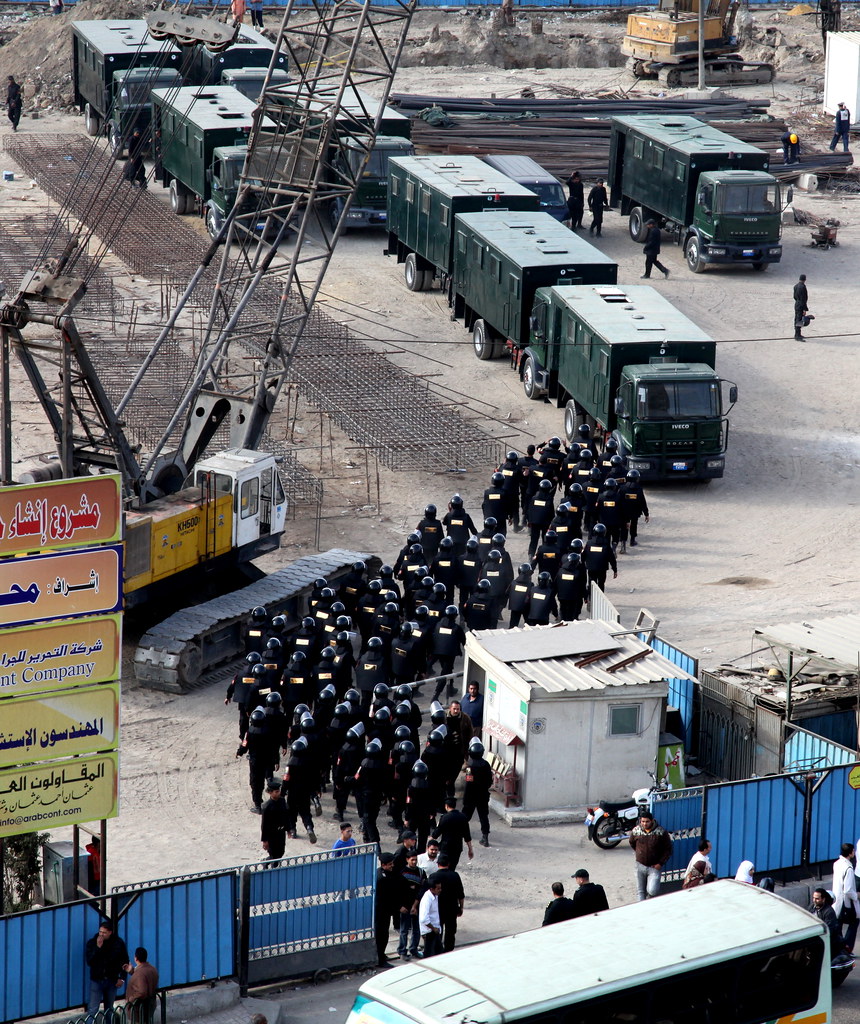
While we had received tentative approval for the March by the Egyptian and Israeli authorities before buying our air tickets, we soon learned that any such approval had been revoked when the Egyptian military police cordoned-off our bay-side gathering on the first night.  They announced over megaphone that any foreigners who pass the cordon would be be considered as participants in an illegal march. 

Being cordoned off by police patrols, it was hard to move along the river front. We had planned to board feluca sailboats to hold a candlelight vigil on the Nile, but were informed that the boats had also been cordoned off at a far-off pier and were blocked by the police.  We still held a candlelight vigil, but since the roads were cut-off and we had been surrounded, the media had little chance to record the event and no locals were able to see the protest.


Over the next two weeks, this would become a recurring theme to the March.

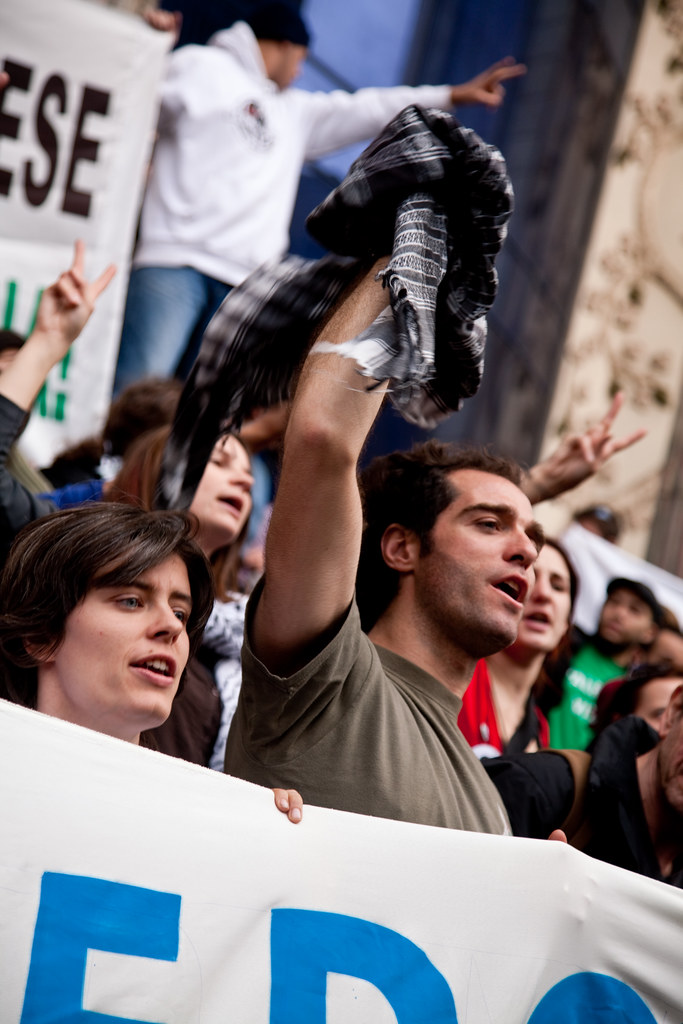
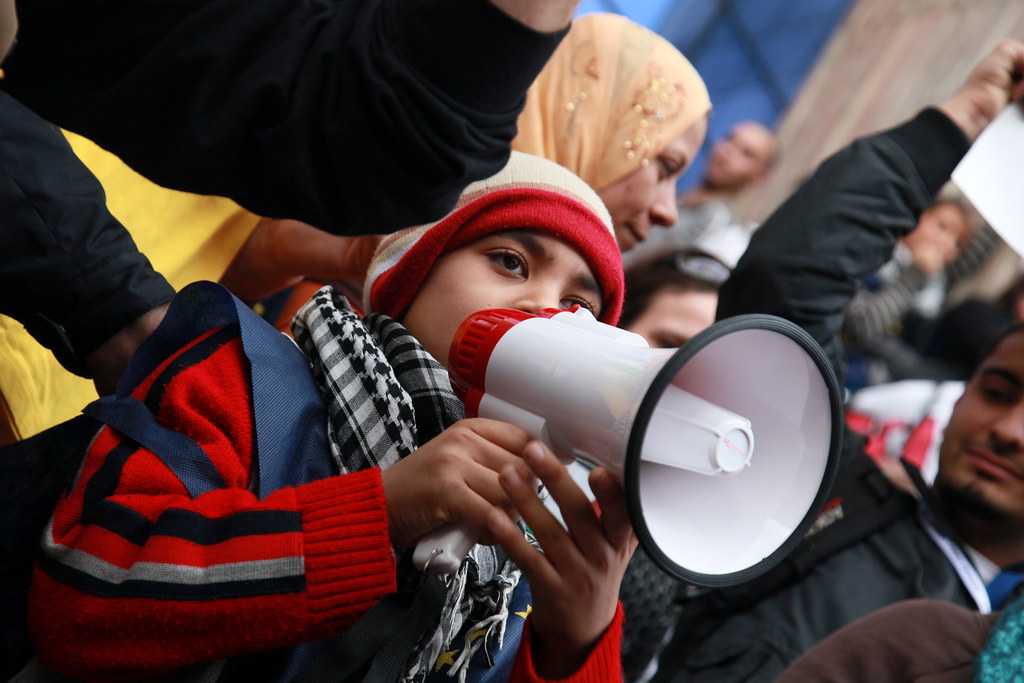
In follow-up protests, there were members from all walks of life who joined in the March. In front of the Journalist's syndicate a young boy gave a speech. He was Palestinian and born and raised in a refugee camp, but had never been able to visit his homeland. He had joined the march with his parents in the hope of visiting his relatives and to see the remains of the home where his Father grew up.


The next stage of protest was quite dangerous. Hedy Epstein, an 85 year old Holocaust survivor and peace activist, began a hunger strike that was joined by many of the demonstrators. I had always heard about people partaking in hunger strikes, but never realized how dangerous they are, until meeting people going into the 3rd and 4th days of their strike. In the following photo, people are going into the second day of their hunger strikes. Over the days to come they began to look ill, their skin became paler and their faces became pockmarked. I tried talking with them to learn about their motivation for joining the cause, but they had become delirious. I and many others were seriously concerned for the health of Mrs. Epstein, but she was adamant in continuing her strike. She continued until the doctor forced her to stop, and she had to be fed through an IV. Although I can't say I have the willpower to endure a hunger strike myself, this experience helped me to understand the power of the convictions held by Mother Theresa and Mahatma Gandhi.


After a week of secret meetings, mysteriously coded phone messages and dozens of aborted plans, on New Year's Eve, we held our largest protest in front of the Egyptian Museum. On streets overrun by secret police, several hundred protesters pretended to be tourists visiting the various tourist traps downtown. So did dozens and dozens of secret police. It was obvious who they were though. Wearing leather jackets and holding faux-guidebooks; the 6+ foot statures,  muscular frames and unnaturally forced questions to bystanders gave them away. 
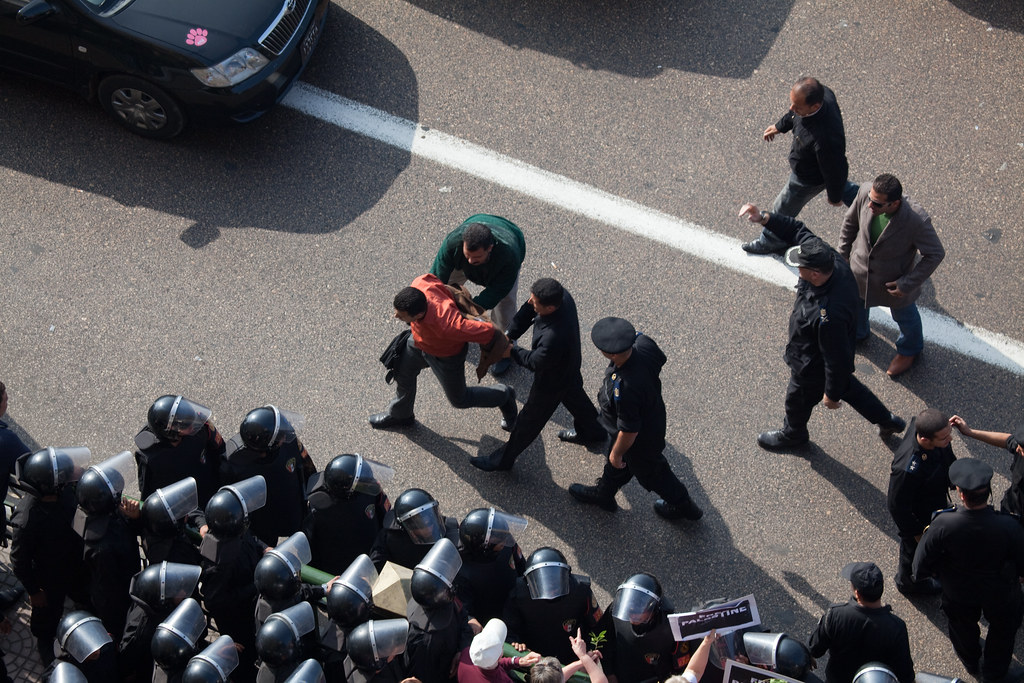


The New Year's Day protest held in front of the Egyptian History Museum, blocked off a major traffic artery for downtown Cairo.
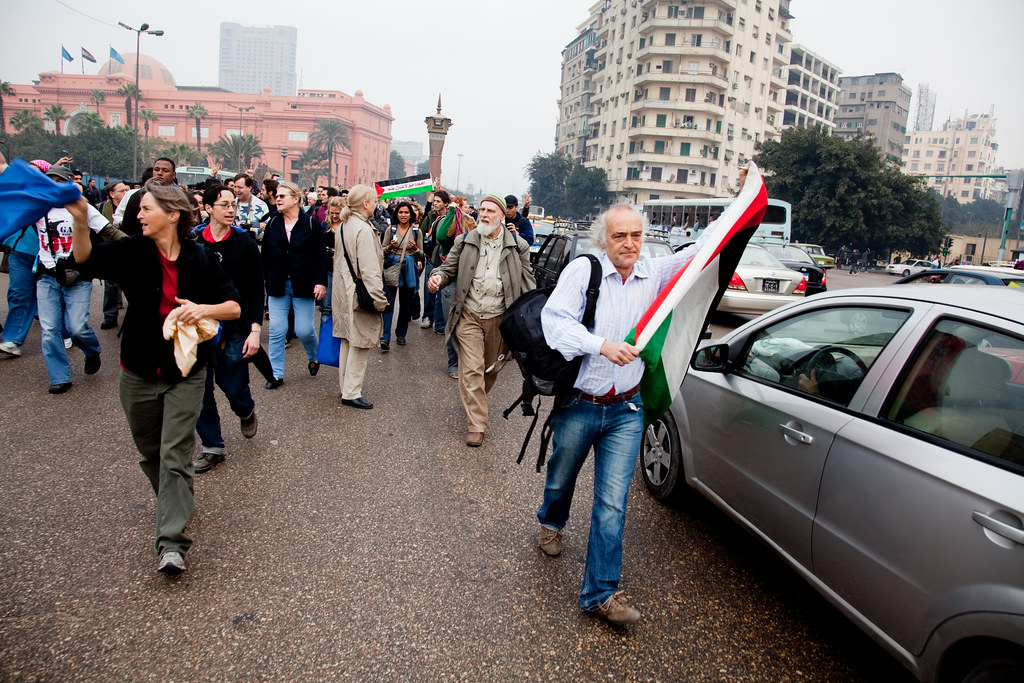


 The New Year's Eve protest finally drew some attention to the cause.
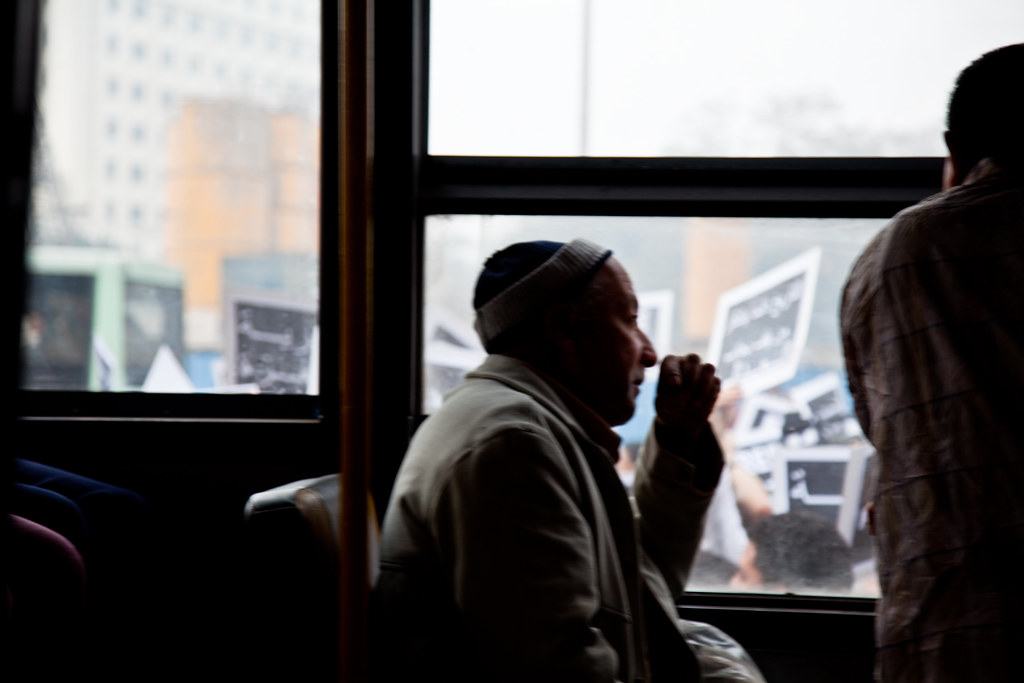


Locals in buses and in stopped cars were able to see the signs. However,  a lack of proficiency in Egyptian Arabic meant that our messages were not clearly conveyed.


The military police were pushy and resorted to occasional violence to shut down the protest as quickly as possible.  
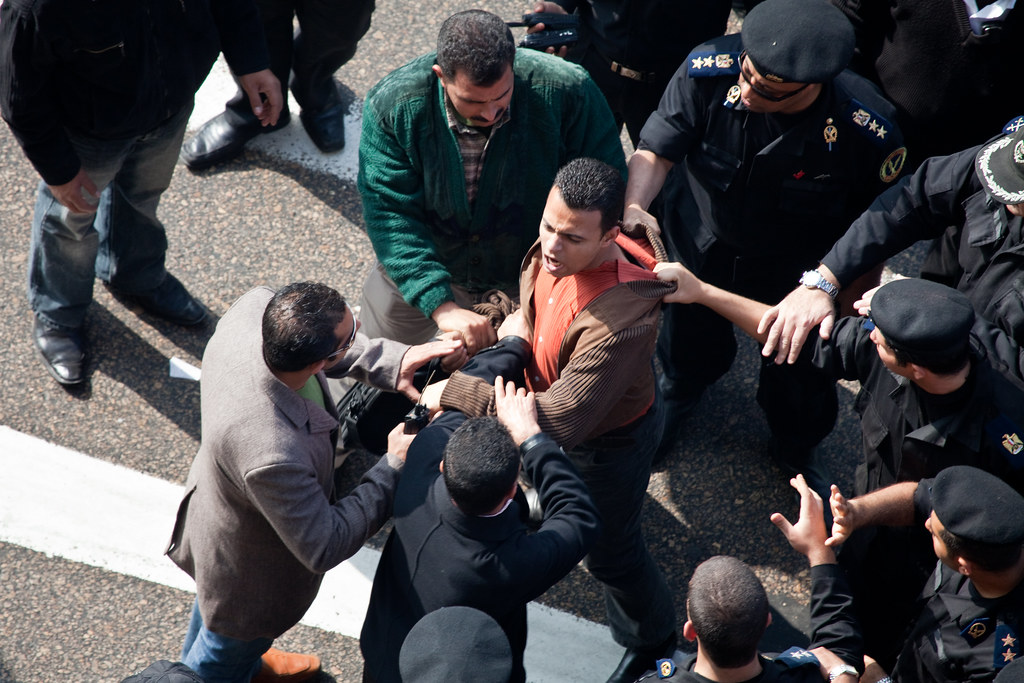


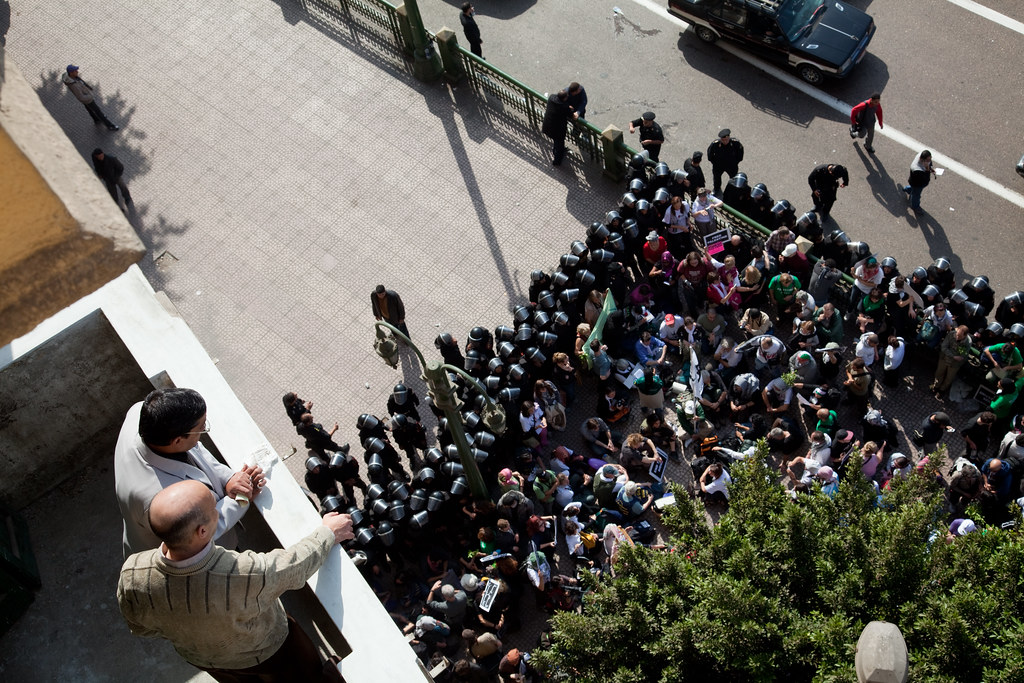
After reinforcements arrived, the police far outnumbered the protesters.


In the end though, it's debatable how many people actually heard the messages of the protesters. Since few statements were prepared in the local language, and local participation was limited to lawyers and journalists, I'm disappointed to report that our actions came to feel like an imported 'protest for protest's sake.' I am very supportive of grassroots protests, but came to feel that this one was too forced and removed from local political movements. In the future I will work harder to document the actions of local protests, especially those by ethnic minorities, and those with more grassroots support by the local population.   Thank you for reading this far.  :D   

10/08/2009

Egypt is truly a land of mystery.


Egypt is truly a land of mystery.

While there are many secrets lost to the ages here the bustling excitement of modern Cairo hides just as many stories as are buried under the whites sands and black sands of the desert.

This first image is of a faceless deity from Karnak temple.When the Bamiyan Buddhas were destroyed in Afghanistan in 2001, the main argument used by the Taliban was that the depiction of deities in art wasforbidden. Until visiting Karnak, I was under the impression that this belief would have led to the destruction of entire works; of paintings, statues, murals, and buildings. The scale of the larger temples in Egypt is astounding. I hesitate to make a modern day example, but those formerly towering Ikea and Costco superstores seem tiny now that I've returned from Egypt. I wish there were other massive-scale architectural feats of the modern era to draw a comparison to, but there aren't many that come to mind beside the temples to the almighty dollar.
 
I'd known that a lot of the ancient Egyptian temples had been harmed by vandals and graffiti over the centuries, but was surprised to see that the clothes, accessories and inanimate objects surrounding the figures in the murals were very clearly preserved. It was only the faces, arms and exposed skin of the figures that had been painstakingly scraped away, and scratched away using crude tools. I can see this happening to a couple dozen figures, but shockingly every single face appearing in wall murals around Luxor and Aswan, that weren't hidden away in sandy tombs until the modern era, were completely chipped away.

For some reason, I found the stares of these hundreds of faces that weren't there anymore, all the more haunting than the unearthed relics in museums that still had their features intact.


The desert.

The sands of the desert and the waters of the seas have much in common. Just as nearly-drowned sailors have recalled visions of mermaids in the deep seas, the vast, flowing sands have been known to consume entire villages, and unearth ancient vessels from a thousand year's sleep. I felt the sands to be hypnotizing and enticing, despite their suffocating aridness, and long to hear the songs of the desert once again.


Our small band of travelers made the journey towards Marsah Matruh, to visit the remote WWII graves of European soldiers at El Alamein. I'm not generally a superstitious person, but there were a few surprising happenings on this particular journey.

To make it out, we had to board a bus from Alexandria. For the giant bus 'terminals' in rural Egyptian transport hubs, there are no terminal buildings, nor clearly marked signposts - In EITHER English or Arabic. Have you ever seen an old Western Cowboy movie, where dozens of stagecoaches form a caravan and circle around? Well, imagine that, but substitute close to a hundred minivans and a couple dozen buses. That is what the rural Egyptian bus 'station' looks like. It'd actually be a brilliant system once one becomes familiar with the language. The drivers call out their destinations, and as soon as enough passengers are gathered they will depart. The term 'Mashrou' roughly translates into 'service taxi.' Imagine the 'airport shuttlebus' system, but make it a lot cheaper, remove any roadworthiness examinations, and spread them all around the country for daily use.

After negotiating with a couple dozen of these shuttle services, we realized that there weren't any that were willing to make the journey out to El Alamein, since there weren't ever enough passengers to make it a profitable route. One driver suggested that we take a service taxi out to a further out-of-town transport hub. It was from there that we caught the LAST BUS towards Siwa. That bus could drop us off within hiking distance of the El Alamein grounds.


On the way to El Alamein, we encountered these photogenic truck drivers. Due to the harsh sun, I DID NOT REALIZE they were posing, until getting back to Tokyo and looking through the photos. There was one other occasion in Egypt when I was completely oblivious to a great reaction by a photo subject. That's this one:


After passing the truck drivers, the rest of El Alamein seemed like a ghost town...   Appropriately, I guess. Since my Grandfather had fought in WWII, and I was now living in Japan. I'd often been conscious of the effects of the War on the 21st century. Of course we all have. Of the Alamein battle, Winston Churchill said:  "This is not the end, this is not the beginning, nor is it even the beginning of the end, but it is, perhaps, the end of the beginning." WWII was a long fought-out battle, but the Battle of El Alamein is symbolic as the battle where the Allied Powers got an important foothold that helped them gain the momentum to begin ending the war. 

We arrived at the British tombs at around 3:00pm in the afternoon, and the first person we'd encountered in close to an hour of walking in the hot Egyptian sun was a security guard at the British Tomb entrance, who greeted us with the traditional x-shaped 'no-entry' guard gesture.

After we asked persistently to be let in past the gate, he angrily pointed out that the closing time was 2:30pm, and that rules were rules.

In Egypt, you eventually learn that 'Rules are rules' but 'Baksheesh' (tips) is the key to breaking ANY rule. "Hey, want to climb to the top of the pyramids??" $150 USD will help you do it at night. That's $25 to each of the 6 guards surrounding it at night. After 'baksheesh'-ing him, I'd wondered if I might be able to find some distant relatives in the British cemetary of El Alamein, and searched around for ages.

At one point, my friend Jamie (the fearless bus negotiator!) yelled out for me to duck, so that he could take a photo of the cemetary. While ducking....    I was shocked to read...


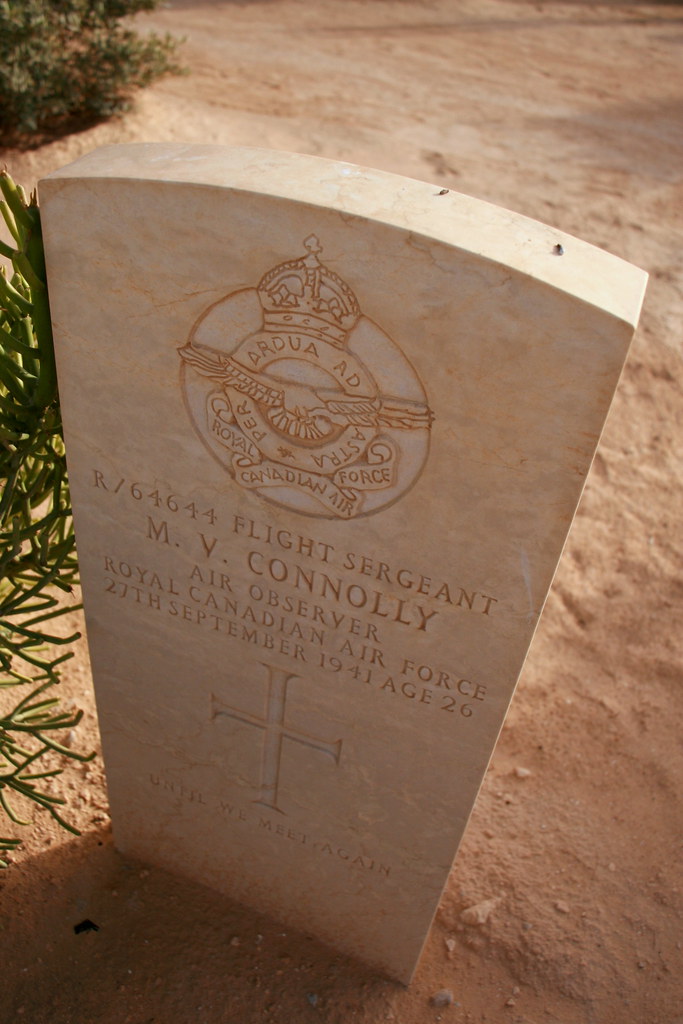
The gravestone infront of me.

This was a British cemetary, so it's not that surprising to have members of the Royal Canadian Military. Despite the logic of that, mysteriously encountering the grave of 26 year old M.V. Connolly, had a deeply humbling effect on me. I let that sink in for a while,

We continued to stroll along the thousands of graves that were set up along several memorial sites for soldiers from Britain, Italy, Germany, and various commonweath countries for much of the early evening. It wasn't until we had hiked back to the highway, before we noticed in our guidebook that the bus that took us out here was the LAST BUS of the DAY that would come out this route.

After freaking out for a while (by the side of the highway in the middle of a ghosttown, near the Libyan border, without any clothes or blankets ready for the freezing Egyptian nights) we eventually managed to hitchhike with a Service Taxi that was rented out to some guys that were importing chirpy little Parakeets from Sweden to Libya....   They were taking the highway at full speed.

Thanks to their speeding, we somehow managed to catch up with the SAME BUS THAT WE HAD EXITED HOURS EARLIER!! At a service station, just where the road makes a sharp turn inwards from Marsah Matruh.

We didn't notice the bus at all.... But the bus driver sure noticed us. He came running out of the service station yelling "Siwa!!"  "You Siwa!!!" "Again!!"

We again boarded that bus, the LAST BUS of the DAY to the Oasis town of Siwa.

This just felt like a natural occurance, you see, on the grave of the young M.V. Connolly

it said:


"Until we meet again."


I guess we did.

9/24/2009

Nearly scared away from journalism

Nearly scared away from journalism

Now I realize that the quality of my writing doesn't stand par with most of the writers already out there, since I rely a little too heavily on cliches and run-on sentences. However, I want to ascertain that becoming a journalist has been a long-standing dream of mine. I have made it into a few riskier countries that are off-the-beaten-path, but to tell the truth, personal safely had been pretty much guaranteed in most of those cases.  I was yelled at by the North Korean Military for taking disaster relief photos, nearly fell down far too many mountains when losing my footing,  and have been chased around in a Hummer by armed guards in Dubai, but in most of those cases the only  real threat was having my photos deleted.

This photo was the last of a particular roll I was shooting, just in the vicinity of Pristina, Kosovo. This situation was similar to the last couple mentioned. I had managed to hitch a ride into a post-war reconstruction area with Stig, the head of a Swedish construction-focused NGO. He would be busy with meetings that afternoon, so I took the opportunity to take a walk around the area where the reconstructed housing was scheduled to be built.  I ended up wandering out of the "secure area" - there were no signs or other demarcations, how could one have known.

I ended up spotting a rather old Greek-Orthodox church of the old order. From what I recall, while much of Kosovo had converted to Islam, the followers of Greek-Orthodoxy moved into modern-day Macedonia.I took this photo as I moved closer to the ruins of the old church. The intricate stonework caught my eye, and strangely enough the KFOR (Kosovar Forces of Resistance) soldiers barely registered in my narrow line-of-sight. Depending on the Political circumstances occuring in a country, you could either only see a civilian police force from time to time, or you might see a constant ocean of soldiers. At the time, certain regions of Kosovo were similar to the latter. Most entry points and secure facilities were under guard by various guises of UN soldiers. Transport conditions between Kosovo and Macedonia changed radically every few days, when different nation's Peacekeepers were assigned border duty. I won't rehash any old stereotypes, but the attitudes of the French, German and US border guards behaved exactly as lax, strict or overconfident as you'd have imagined them to.

So, seeing soldiers in the corner of my eyesight never really caused me to have second thoughts, as I assumed they were just another incarnation of the various UN forces.

Shooting away, I switched rolls after capturing the up-close shot of the church, that is the next shot in the gallery. When you take photos you aren't supposed to, but need to take for the sake of journalism, you learn a few techniques for quickly switching out memory cards and rolls of film. I forgot where I stuffed this last roll, but let's just say they'd have to look pretty carefully to find it.  I recommend having a spare memory card on hand with A bunch of REALLY POORLY TAKEN, seriously up-close self-portraits with vague blurry backgrounds like the sky. If you can switch this into the camera quick enough at a security stop, the guards won't bother looking for the "spy shots" that they are monitoring for.  Just remember not to accidentally include these shots in a professional slideshow presentation of your journey.

Anyways, one of the guards started calling out to me in what I'd assume was Serbo-Croation. So "Zdrabvo!" (Hello!!) I called out back to him. He continued calling out, but I shook him off as an overly-polite stranger, and continued to creep closer to the old church, trying to take some cool shots of the rusty padlocks and the latticework in the doors. At this point, he was not so much yelling, as he was screaming at me.

Lo and behold, I turn around and there are two soldiers who are rather, shall we say, displeased with me, and rather than waving towards me, are instead sticking out their rifles at me. Charming...

I likewise responded with the universal peace symbol, the hands-up-no-sudden-movements pose.  This, they appreciated, and the closer one of them responded in kind by prodding me with his rifle's tip, and grabbed the camera from my neck. Likely following the How-deal-with-journalists-playbook, he promptly proceeded to open the filmback of my camera, tore out the film, and tossed the camera, exposed film cartridge still attached, into the dirt. Despite the rifle still pointed in my general direction, my eyes dart down towards the camera, and the only thoughts that pulse through my concrete-thick noggin are 1) the film is a goner, and 2) I didn't hear the lens crack. *phew*.

So I reach down very slowly, and carefully pick up my camera, letting the film trail out onto the ground and abandoning the film and cartridge on the ground. You know when Gollum of Lord of the Rings has the smacked out of his hand?  That's how most photographers will naturally react when you tear a camera out of their hands, or how Russel Crowe reacts when his photo is taken.  However...   playing it cool, I simply picked up the camera, with one of the filmback-door-hinges snapped off, held it close to my chest, and backed slowly, very slowly, z.e.n. m.e.d.i.t.a.t.i.o.n .s.l.o.w.l.y....    and moved away from the scene.

Curiously, it wasn't until two days later, when I accidentally let some of the details of the event slip in a conversation with the volunteer-supervisor, that I began to have an emotional reaction to the event. The supervisor explained quite clearly how the soldier was under no commitment to let me leave. International Law and War-Criminal-Trials aside, If I were to have disappeared at that junction, there would be no questions directed towards that soldier, and since I hadn't properly explained my day's plans to the supervisor, (obviously not, since it would have been rejectied) the volunteer group, and associated NGO's would have no leads to go on, as to my whereabouts. That could have been the end.

It was a minor incident, and the odds of it having actually resulted in my disappearance were probably quite low when calculated statistically. However, feelings are not a direct result of logic, and that incident ended up scaring me away from danger spots rather prematurely. It was the following year when I decided to visit Japan for the first time, because it was so much safer. Safer perhaps, but I think after a decade since visiting Kosovo, I'm about ready for some more excitement again.

9/07/2009

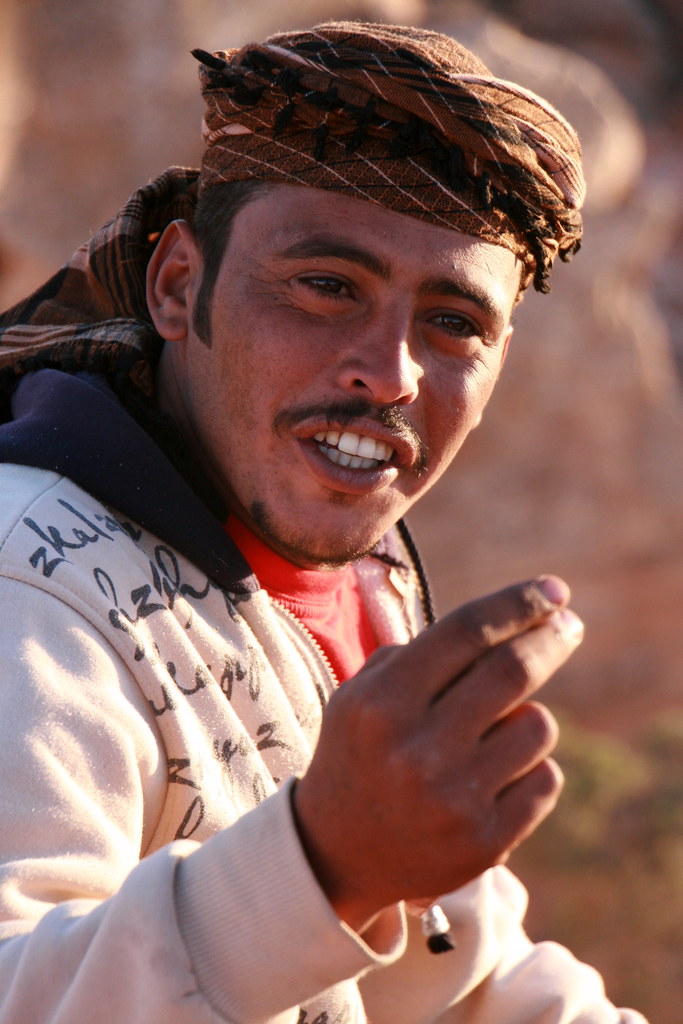
The drunken camel guide of Petra


I think we've all had our encounters with incredibly fascinating people, whose life experiences can really inspire us, and move us... except that, for some reason we're occasionally/often scared away from such a person from their intensity.

On my second day visiting the Petra Complex in Jordan, as seen in the 3rd Indiana Jones movie, I ended up with a climbing group consisting of a French backpacking couple, a Japanese and a Korean backpacker as well. As a group, we bought an impromptu lunch set, consisting of Pita bread (stolen... ah, borrowed from the hostel's breakfast table), little packs of cheese, some oranges, and a curious, giant, foamy-type of sausage... (Some kind of processed meat, or meat-substitute?), and set out to climb up to the highest point, the Sacrificial Peak (for ancient air burials) as the day's goal.

The Petra complex itself is incredible... The "Treasury" is usually the feature shown regularly on travel documentaries (and in I.J.3) but, but it pales in comparison to the massive "Treasury" facade towards the summit of the "End of the World," which is where a mountain range, and ridiculously deep valley create the natural land border between Jordan and present-day Israel. However, taller and wider than the Treasury, is the "Monastery." Which was carved by hand (and basic tools, of course) around the 1st century BC, by the Nabataean people. It takes at least an hour-climb to reach the site, and the "Monastery" facade stands 50 m high x 45m wide. There are quite a few photos of both sites in the Adjoining album.

The amazing thing about visiting the Petra complex, is that after a few days of climbing through the 2000 year old ruins, you begin to realize that the site hosts an ENTIRE, self-supporting city infrastructure, carved out of the mountain facades. Temples, living quarters, store fronts, sacrificial grounds, giant monuments, horse stables, you name it... everything carved out of sandstone as far, nee farther, than the eye can see.

On the second day, our group made our way arduously along several of the mountain paths, enjoying our lunch in the mid day sun, and making it to the Sacrificial Peak, perilously close to sundown.

While choosing some nice grooves in the mountain face, to rest and relax for a bit, a camel guide started yelling out to our group. We ignored him at first, but he was rather insistent in asking, then telling, then yelling at us to move over to his cliff spot to join him. Since we had found such cozy grooves, it took a while before we were willing to relent and trotter over to his spot.

Once we finally pottered over, his first greeting was to gesture that he wanted a cigarette.

By the time one of the French members got rolling papers from his backpack, and handmade a cigarette for the fellow, we came to realize that there were a lot of little liquor bottles gathered next to him... recently emptied it seemed. He then introduced himself as Abdullah.

He began with his set speech about the history of the region, and the laborious work that went into producing the site... but slowly started moving onto interesting, if not surprising subjects. Initially, that his family dated back to this site for generations and actually owned and lived in some of the rock-carved apartment huts. However, were pressured to move into government subsidized housing complexes a stones-throw away, when the site was declared a World Heritage Site. He pointed the houses out, and told us about his extended family.

First, was that he constantly bragged about the benefits of camel milk....

He told us that his Dad had three wives, and that he was the son of the second wife. He told us that his Father was a proud and virile man, capable of producing however many children any time he wanted.... the secret of which... I didn't discover until getting back to the hostel.

The next story, that kind of brought the reality of sitting over a mountain cliff to the forefront, is that he then went on to talk about the "cleaning crews" and how there's often nothing that they can do. These crews, you see, weren't litter cleaning crews, but body cleaning crews...

It didn't happen too often, in fact, only once every three or four years, but still enough to seem to have an emotional effect on our new friend. As he took that chance to open a new bottle of vodka that he unsheathed from his hoodie, and take a hearty swig. He pointed out the couple spots along the cliffs that tourists had lost their footing, or tried climbing foolishly and couldn't recapture a handhold. To really drive in the fact, he would point out his finger, and drag it down while making a whistling sound. "pssssss...sss...ss..s......crrrRCHh"

That's got to leave an impact on ya.

It was around this time that we realized that we had passed sunset, and the skies were darkening quickly.... Compounded by the fact that we had just heard some nasty stories, we realized it was time to start rushing back down the mountain.

He invited us out to visit a campfire set up by the other guides in the mountains, and we had to reject. He ended up calling out quite persistently, down the mountain, that we join him.

Similar to the Egyptian story, some people might say in hindsight that he may have planned to con us, or charge us for guidance to the exit, in the darkness.... but I really got the impression that it must really be quite lonely, being a mountainside camel guide. .. Oh, and that I need to be more careful when climbing in the future. :D


PS: At the hostel I learned that "Camel Milk" is considered to do domestically produced "Viagra" in Jordan. :b

North Korea - At the the end of the tunnel


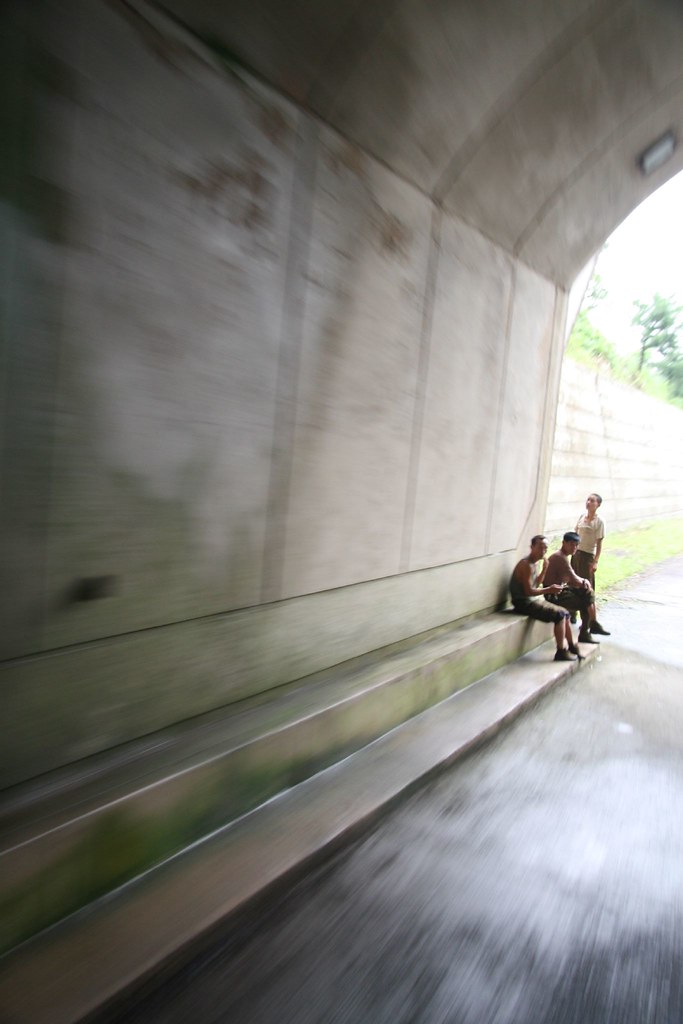
This is one of the first pics I took in North Korea to really start leaving an impression on me.

This was taken through a cracked open window, on the bus heading down the "highway" on the way towards Kaesong Village. I put "highway" in quotations because in the 2~3 hours we were driving, we only encountered 8 or 9 vehicles total. That includes the construction dump-trucks that served as buses for the junior-military (AKA: construction crew) and the radio-trucks for blasting "patriotic" music to inspire the workers during their backbreaking duties.

A week before we flew to North Korea, on October 18th 2007, there was a series of torrential rainstorms that flooded and ruined farmland, and devastated many mountainside villages. Under the support of the Soviet regime, the industrial machine of North Korean industry dramatically outperformed that of the Agrarian South Korea of the 60's and 70's. However, such dramatic industrialization had a devastating effect on parts of the landscape, and large swathes of the forests along mountainsides were cleared out, without any seedlings planted in their wake.

Following decades of deforestation, the gradual cycle between alternating periods of floods and droughts, now leads to serious landslides that afflict many of the mountainsides across the country. I caught these workers under a bridge, just before exiting the tunnel, and getting my first sight of the results of those landslides.

I decided to display this one, rather than the following pics of the roadside labor crews, that were trying to stem the flow of the landslides, and reconstruct collapsed infrastructure, using only their bare hands, crude tools, and Oxes. The only vehicles used for this work, were dump-trucks that doubled as buses and trucks... that simply served as radio loudspeakers.

The people I met in North Korea were quite warm and friendly, and certainly had their own complicated personal lives, and loving relationships with friends and family. I interviewed a girl, whose parents were soldiers, but she was going to University to become a movie scriptwriter, and I interviewed guys who like to play soccer and go drinking with their buddies on the weekends. Strangely enough, most of the people I talked to were politically apathetic for the most part. To be safe they had to tow the political line, or suffer the consequences... but being so busy, stressed, and involved in their personal lives. Including many who are struggling just to put food on the table, literally. I didn't come across much discussion of the direction the country was going in. From the outside, I guess it's relatively easy to get an idea of the impression your country is leaving on the rest of the World, but when you're inside and only exposed to domestic media, it's that much harder to gain a wider perspective, and that much harder to begin sowing the seeds that lead to political change.

I'll go into detail in future entries, but one of the main inspirations for my graduate research, was discovering the underground NGOs that are focused on not just getting news and information out from North Korea, but also ones, like AsiaPress, NKNet, and Radio Free Korea, that are focused on getting information out-of, into, and around North Korea. It's really hard to be critical if you're not aware of the problems, and the only way to do that is through a free press. While a free press is still illegal in North Korea, and crippled and compromised in many other countries, active support for underground-citizen-journalism in countries without the right-of-free-speech is an important step on the road to finding the light at the end of the tunnel for those still living under dictatorships.

Kosovo Volunteering 1999 - the children and the car


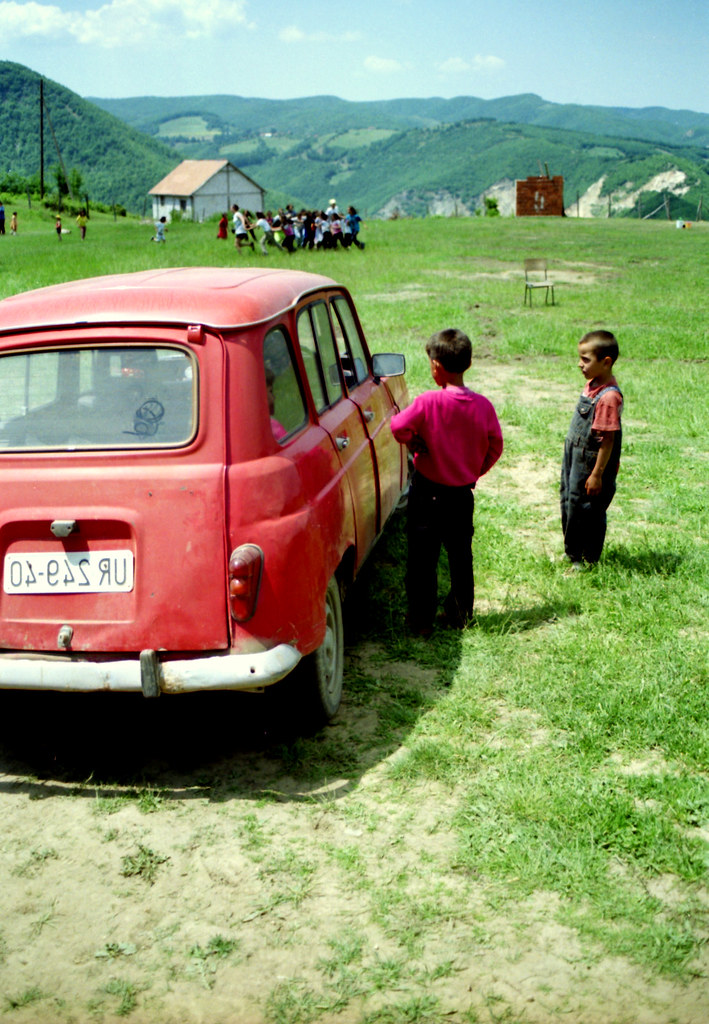
I'm not sure exactly what it was that reverberated within me after taking this photo, but it was a serene moment. This was taken in '99, during my first year of undergrad, where I had the incredible opportunity to accompany a small group of intrepid volunteers.

That's a whole other story there, but the set up around which this photo was taken is that our group was traveling around some of the war-affected areas in Kosovo, setting up little impromptu carnivals for the kids. I really like the mass of vibrant energy in the background. That is a group of kids being chased around by some of the volunteers in a game. That building is the entire school building for grades 1 through 6 of an ethnic Albanian town just outside of Pristina. Since it's a single room schoolhouse, grades 1~3 were taught together in the mornings, and 4~6 were taught together in the afternoons. There was no running water at the school, and washrooms were cleaned by the students themselves using water taken from a stream down the mountain.

In contrast, the Serbian schools we'd also visit during the trip, were large, air-conditioned, beautiful buildings right out of the Sound of Music. Of course, if you see the mountains in the background, almost all of Kosovo is an incredibly beautiful country with a Mediterranean climate. I was quite surprised to arrive, because in the news Media of the time, I could only remember rocky ruins, and desert villages suffering from bomb damage. The actual beauty of the landscape upon arrival was quite disarming.

I don't know what the kids in the foreground were thinking, and I couldn't have know even if they tried telling me, because the only Albanian word I knew at the time was "Toong" (hello)
Most likely they were simply thinking it was a cool car, but there was something about their body language, and their pause... that made me think they were reflecting upon something deeper. I'd like to think of this car as a means to their future. This photo was taken a decade ago, but, it was only a couple of years ago that Kosovo finally achieved its independence after a very difficult period. If only it weren't so difficult for people to find a place they could call home.

7/25/2006

落ち着いた雰囲気?  (大引越し1の前)


ケベックの旅行 003
Originally uploaded by Ryuugakusei.
今は不思議な落ち着いた気持ちを感じている。
今週末は一年ぶりに「大引越し」が来た。一年間は香川県の三豊市で国際交流員として働いた。最初からは三年間やろうと思っていたが,元々働いていた町が合併に捕まれて,僕の役がリストラされた。変な状態でJETとして国際交流員の役を「リストラされるしかなかった」と予算のきつさで言われたが,その後個人で契約のオファーが来た。新しいオファーの給料が先より三分の二だけではなく,JETの研修や通訳の講座には参加出来なくなるので僕その新仕事を断った。

   まあ,それと..  田舎に住む体験が出来た良かったと思うが,人生を成長させるために次のロールに続けた方が良かっただろうと考えて来た。来週から大阪に引越しして,カナダの領事館でしばらくインターン・プログラムに参加する事となった。始まると,すぐMIXIやブログでアップデートしるので,何か質問等があったら自由にコメントを下さい。

   そして,九月から日本で大学院生になる。 研究と論文の全部は日本語と韓国語でしなければならないが...  頑張ろう!!!!

    写真は,カナダのケベック州のモントリオール市で撮った。ポストのテーマとは何か違うが,今の自分の気持ちとは,なんとなく,マッチした。

   また宜しく! 

7/23/2006

A Basic Outline of the Japanese Educational System


東京2006六月 117
Originally uploaded by Ryuugakusei.
I'm entering the system towards the latter end of the cycle over here, but have managed to accumulate some teaching experience at a few of the levels. So I thought I`d try outlining the basic levels Japanese education system their accompanying ages/grades. I've written this in an overly simplistic manner, so please feel free to add commentary and corrections as you might see fit.

システムの最後の方から入ろうとしているが、いろなレベルでの教える体験はもう出来ているので、簡単な言葉を使って英語で日本の教育システムについて紹介しようと考えていました。何か情報が足りないか間違えている事を見つけましたら、ご自由にコメントを通じて教えてください。また宜しく!

日本の教育システムのレベルと説明:

保育・幼稚園 (Hoiku/Youchien) Houiku is preschool and has children as young as two in attendance. Youchien is the Kindergarten equivelent, and accomodates children up to 5 years of age. These are generally privately operated, but many of the small towns that haven`t yet been hit by `amalgamation fever` often run their own Hoiku/Youchien centers.

小学校 (Shogakkou) shogakkou is elementary school and covers children from 6 years of age to 12 years. Until just a few years ago, half-day classes were required on Saturdays. However, following some of the political movements to cut down on `student stress levels` obligational Saturday classes were removed from most school boards. As of 2006, the National government has introduced a plan to incorporate basic English classes into the elemtary school system. (But... doesn`t seem to have come up with a solid plan to implement this requirement.)
In Japan, class sizes are very large, and most classes are conducted in the lecture/note-taking style. An interesting touch is that clean-up of the school and lunch distribution are taken care of by the students. There are daily `cleaning periods` where classical music is played, and the entire student body takes care of the various clean-up tasks. Including sweeping, mopping, wiping and washing the blackboards, picking weeds, wiping the desks, cleaning up around the pool (many elementary schools have their own pools!!) and cleaning up the Unicycle range. (All the elementary school`s I`ve visited have enough unicycles on a rack for an entire class at a time!!!) At lunch time, all of the students have a `lunch prep uniform` including a white hat, mask, gloves and doctor-style robe/jacket. All of the students walk down to the lunch distribution room with the Teacher, and carry each of the pots, spoons, bins, and milk cases to the classroom in pairs. Each student brings their own cloth table napkin, chopsticks, cup and toothbrush. After the lunch is distributed, extra food is distributed through `paper-rock-scissors` challenges among the classmates, and the end of the lunch period is accomodated by a song for synchronized toothbrushing.


中学校 (Chuugakkou) Chuugakkou is middle school/Junior Highschool and last for 3 years, from 12~15. The types of classes are similar to North American ones, but I was surprised to hear there aren`t any Design and Technology courses. Sports clubs begin at the Chuugakkou level, and are very time intensive. When one joins the Baseball, Kendo, Karate, Volleyball or etc... club, they are expected to practice each day on Monday to Friday after school for 2~4 hours, and also for a half-day on Saturdays. Saturday classes were dismissed with the `stress-reduction` educational movement a few years ago, but Saturday sports practices have filled up that resultant gap. Until 2006, English curriculum begins at the Chuugakkou first year level as a mandatory subject, and continues through Koukou/Highschool. A curious feature of the Japanese system has been the introduction of the ALT (Assistant Language Teacher) through the JET (Japan Exchange and Teaching) Program where Foreign University graduates are recruited to assist English classes at the Jr. and Sr. highschool levels.

高校 (Koukou) Koukou is the highschool equivelent. Classes are mostly a continuation from the Chuugakkou curriculum, but a few optional courses are added and the availability of afterschool clubs/sports are expanded. Koukou runs from mid 15 to 18. A really important element that I didn't mention earlier is that progress from each level of schooling is not determined by class marks and attendence, but is determined by the entrance examinations for the following level of education. Because the content of the entrance examinations for the next level of education are often arbitrary to the educational requirements of the former level, a majority of students are systematically forced to begin attending private Juku. (Cram schools) Because students marks aren`t relevant to a student`s educational continuance, and teacher evaluations are not conducted, the prevalence of the Juku system has led to some serious academic discrepancies. Many teachers `moonlight` at evening Juku`s and are said to `conserve` their energy for their evening classes. (Where teacher evaluations highly affect the teacher`s salary.)


大学 (Daigaku) Daigaku is University. University in Japan has three classifications. 専門学校: (Senmon Gakkou) Specialty schools, similar to the Canadian equivement of a Specialty College (As opposed to a University.) There is 短大 (Tandai) which is a 2-year college course. These are for students who wish to enter the workforce quickly, and then the 4-year 大学 (Daigaku) for students looking for honour degrees, or to continue their education. A curious feature is that if a student can pass the incredibly difficult entrance exam to enter their school, graduation is pretty much guaranteed. Graduation essays are not often required, and students will take an absolute minimum of classes in their 3rd and 4th years to conduct 就職活動 (Shuushoku Katsudou) or the Job search. Companies in Japan hire graduates at least a year before their Graduation. Taking a year off after Graduation (to `find` one`s self) is frowned upon, and having gaps in a resume can lead to many difficulties during a job search.

大学院 (Daigaku-in) or Graduate school. This is where I`m entering the system. I`ll be entering at 26, but the average starting age is 22 or 23 following University Graduation. Entrance general consists of an even more impossible exam than the Undergrad one, but there are exceptions to the rule. I've managed to get through on the strength of a research proposal (4000-Sino-Japanese character length) and Interview. I will certainly devote myself to my own research, but Graduation from Japanese Graduate schools is nearly guaranteed after two years. (The emphasis having been put on the entrance exam...) which has resulted in many Japanese Grad schools having a rather poor International ranking. Most of my former Professors have seriously recommended that I consider attending Grad school in the States, but as my research is focused on minority groups in Japan and I`ve gotten comfortable with the details of my upcoming scholarship I'm prepared to settle down here for the next two years...

博士 (Hakase) or PhD... Dear goodness...
I can only speculate......... I`ll look into the details and update this posting once I stop freaking out about writing having to write my Graduation thesis in Japanese.......... (>o<) D`oh!!! What was I thinking when I applied...